
Technical Guide
How to Select a Sponge Iron Deaerator for Chemical Plants
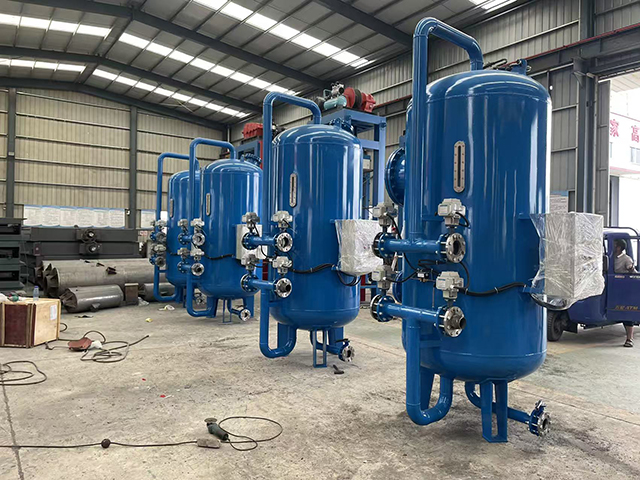
A sponge iron deaerator removes dissolved oxygen from boiler feedwater by passing the water through a bed of porous, high-surface-area iron, where the iron oxidises sacrificially instead of the boiler and condensate system. For chemical and petrochemical plants the selection usually turns on five numbers: make-up or feedwater flow, inlet dissolved oxygen, target outlet oxygen, water temperature, and the iron carry-over the downstream system can tolerate. Get those five wrong and the unit will either under-perform or plug within a year.
How a sponge iron deaerator works
The active medium is sponge iron: a porous, partially reduced iron granule with a very high internal surface area. Feedwater percolates through a fixed bed, and dissolved oxygen reacts with the iron surface, forming hydrated iron oxide that remains largely within the granule. The overall reaction is essentially Fe + O2 + H2O to iron hydroxide, so roughly 3.5 kg of iron is consumed per kg of oxygen removed stoichiometrically; in practice plants see two to four times that because of passivation and uneven bed utilisation.
Because the reaction is chemical rather than thermal, the unit works with cold water. Typical inlet temperatures are 10 to 60 C, which is a genuine advantage where low-pressure boilers take cold make-up and no reliable LP steam header exists for a thermal deaerator. Typical outlet dissolved oxygen is 0.01 to 0.05 mg/L, comfortably inside the 0.007 to 0.05 mg/L feedwater targets most chemical plant boilers use, provided the bed is sized and operated correctly.
Designs normally include a downward-flow pressure vessel, a graded gravel or support layer, a backwash and rinse connection set, sampling points above and below the bed, and a differential pressure tap across the medium. Some units add a downstream polishing filter to capture iron fines.
Where it fits, and where it does not
Sponge iron is strongest where water demand is modest, intermittent or cold, and where steam for a thermal deaerator is expensive or unavailable. It is weaker where flows are very high and continuous, or where the plant cannot accept any iron in the effluent.
| Option | Typical outlet DO | Water temperature | Steam required | Main constraint |
|---|---|---|---|---|
| Sponge iron (redox bed) | 0.01 to 0.05 mg/L | 10 to 60 C | None | Medium replacement and iron carry-over |
| Thermal (steam) deaerator | 0.005 to 0.015 mg/L | 100 to 105 C | 0.1 to 0.3 kg per tonne water (typical) | Steam availability, height, hot water handling |
| Vacuum deaerator | 0.02 to 0.05 mg/L | 30 to 60 C | None | Vacuum pumps, seals, maintenance |
| Membrane contactor | 0.005 to 0.05 mg/L | 10 to 50 C | None (sweep gas) | Fouling sensitivity, module cost |
Values are typical industry ranges for screening, not certified performance. Always size against your own water analysis and load profile.
The five numbers that size the unit
Bring these to any supplier and the quotation becomes comparable:
- Design and peak flow. Size on peak make-up plus condensate return, and state the turndown. Beds below roughly 30 percent of design flow tend to channel.
- Inlet dissolved oxygen. Cold water saturated with air sits near 8 to 10 mg/L at 20 C; hot or partly deaerated water is lower. Measure it, do not assume.
- Target outlet oxygen. A 0.05 mg/L target and a 0.01 mg/L target produce different bed depths and medium volumes.
- Temperature and pressure. Vessel rating is usually 0.6 to 1.6 MPa, but confirm the feedwater pump head and any backwash pressure.
- Water chemistry. pH, chloride, hardness and suspended solids all affect medium life. Free chlorine and oily condensate are particularly damaging.
Superficial velocity is commonly held around 10 to 20 m/h with bed depths of 800 to 1500 mm; backwash at 30 to 50 percent bed expansion is typical. Ask for the velocity, empty-bed contact time and medium volume in writing so you can compare bids on the same basis.
Materials, standards and test methods
The pressure envelope is usually carbon steel with an internal coating or a stainless wetted liner for aggressive condensate. Specify the design code explicitly: ASME Section VIII Div. 1, EN 13445 or GB/T 150. For European installations the unit must satisfy the PED 2014/68/EU with CE marking, and welding should follow ASME IX or ISO 9606-1 with radiography or ultrasonic testing on longitudinal and circumferential seams per ASME Section V.
Performance testing matters more than the shell. Agree in advance on the oxygen method: ASTM D888 or ISO 5813 (indigo carmine) for low-level dissolved oxygen, with a calibrated membrane probe for continuous monitoring. Total iron in the outlet should be checked by ASTM D1068 or ISO 6332 phenanthroline, and a factory hydrotest plus a documented 24 to 48 hour circulation test on the actual medium is a reasonable acceptance basis. Surface preparation and painting to ISO 12944 C4 or C5 is worth specifying for coastal or chemical-plant atmospheres.
Manufacturers working to ISO 9001:2015, ISO 14001:2015 and ISO 45001:2018 should be able to show the corresponding certificates and the welding and NDT records with the vessel.
What drives the price
Two units with the same flow can differ by a factor of two on price. The usual reasons are the pressure rating and material of the shell, the volume and grade of sponge iron, the number of valves and the level of instrumentation, whether a spare bed or duplex arrangement is included, third-party inspection and witness testing, and export packing. Medium quality is the hidden variable: a denser, more uniform granule with controlled porosity costs more but lasts longer and produces fewer fines, and it is usually the right choice where the boiler is unforgiving.
Deep-drawing or non-standard nozzle orientations, extra sample coolers and analyser racks add cost but rarely regret. Conversely, cutting medium volume to save money is the most common false economy in this equipment category.
What goes wrong in service
- Channeling and short-circuiting. Usually caused by poor initial backwash, incorrect grading of the support layer, or running far below design flow. Symptoms are early oxygen breakthrough at the outlet.
- Medium compaction and cementing. Iron hydroxide and hardness scale bind the bed together, raising differential pressure and eventually forcing a full medium replacement.
- Iron fines carry-over. Visible rust in the feedwater and deposits in the economiser or superheater. A downstream polishing filter and correct rinse procedure after backwash prevent most of it.
- Premature exhaustion. Free chlorine, high dissolved oxygen spikes from cold make-up, or oily condensate consume the medium far faster than the design calculation predicted.
- Analyser drift. More oxygen problems are diagnosed from a fouled probe than from a genuine bed failure. Keep a second measurement method available.
Medium replacement intervals of 12 to 36 months are typical, with the shorter end of that range for high-oxygen, high-flow duty. Plan access, drain and medium handling before the first charge, not after.
Selection checklist before you issue an RFQ
- Water analysis: inlet DO, pH, chloride, hardness, iron, suspended solids, temperature.
- Flow profile: normal, peak, minimum and daily pattern.
- Required outlet DO and the measurement method you will use to verify it.
- Design pressure, design temperature and design code, with PED or other marking requirements.
- Medium volume, bed depth, superficial velocity and backwash rate stated in the offer.
- Shell material, internal coating or liner, and corrosion allowance.
- Instrumentation scope: DO analyser, differential pressure transmitter, sampling points.
- Downstream protection: polishing filter, iron monitoring, or both.
- Medium supply and disposal plan, plus spares for the first two years.
- Inspection and documentation: NDT records, hydrotest report, factory performance test, and packing suitable for sea freight.
Getting a technical review
If you are replacing a thermal deaerator on a low-pressure boiler, adding a packaged boiler to a petrochemical site, or simply want a second opinion on a proposed bed volume, send the water analysis, flow profile and a sketch of the available space. The engineering team at Lianyungang Huaneng Power Auxiliary Equipment reviews these cases against the sponge iron deaerator range and can propose a configuration with stated velocity, medium volume and outlet guarantee. Companion equipment such as downstream polishing filters and chemical dosing packages is normally quoted alongside, since oxygen removal and scavenger dosing are usually designed together. For a formal review, submit drawings and specifications through the quotation request page.
Key takeaways
- Sponge iron deaeration is a chemical redox process that works at 10 to 60 C without steam, typically reaching 0.01 to 0.05 mg/L outlet dissolved oxygen.
- Size on peak and minimum flow: superficial velocity of 10 to 20 m/h and bed depth of 800 to 1500 mm are common, with turndown below 30 percent risking channeling.
- Specify the pressure vessel code (ASME VIII, EN 13445 or GB/T 150), PED marking where applicable, and the oxygen test method (ASTM D888 or ISO 5813) before order.
- Most in-service failures trace back to channeling, bed compaction or iron fines carry-over, so backwash design and downstream filtration matter as much as medium volume.
Frequently asked questions
What outlet dissolved oxygen can a sponge iron deaerator realistically achieve?
Typical designs reach 0.01 to 0.05 mg/L from an inlet of 8 to 10 mg/L at ambient temperature, which suits most low and medium pressure boiler feedwater targets. Reaching the low end consistently depends on bed depth, flow velocity and a properly backwashed medium.
Does a sponge iron deaerator need steam like a thermal deaerator?
No. The reaction is chemical, so the unit operates on cold or warm feedwater without steam injection. That is its main advantage where LP steam is scarce or where a thermal deaerator would need a tall, hot-water-rated structure.
How often does the sponge iron medium need replacing?
Intervals of 12 to 36 months are typical, driven by inlet oxygen load, flow rate and water chemistry. Free chlorine, oily condensate and hardness scale shorten life significantly, so upstream protection and periodic differential pressure monitoring are worth building in.
Will the deaerator add iron to the boiler feedwater?
Some iron carry-over is normal, particularly after backwash or medium replacement. A downstream polishing filter and a proper rinse sequence keep outlet total iron within the low levels boiler manufacturers expect, typically below 0.05 to 0.1 mg/L.
Need this equipment for your plant?
Send your duct layout or process data and our engineers will review the selection and return an itemized quotation.
Request a Quote