
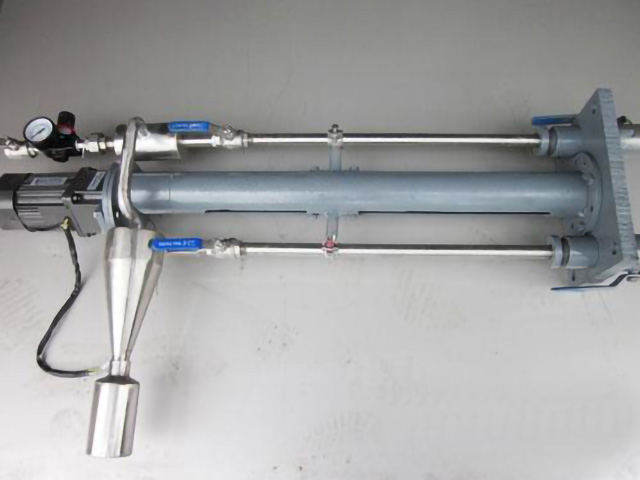
Coal Powder Sampler
Pulverized coal Sampling devices are indispensable specialized equipment in the pulverizing systems of…
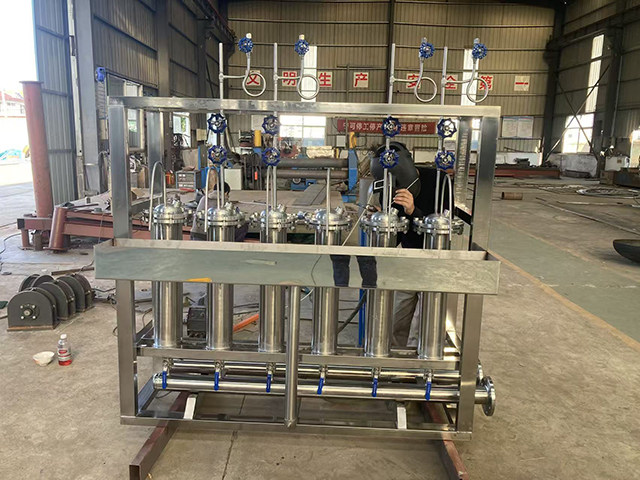
What Is a Sampling Cooler? A sampling cooler, also called a sample cooler, is a compact heat exchanger designed to cool hot process samples before they are collected, measured, or analyzed.
A sampling cooler, also called a sample cooler, is a compact heat exchanger designed to cool hot process samples before they are collected, measured, or analyzed. Sampling coolers are widely used in boiler water sampling systems, steam sampling systems, feedwater monitoring, condensate analysis, power plants, chemical processing facilities, industrial boilers, and laboratory sampling stations.
In many industrial processes, the fluid being sampled may be at a temperature and pressure that make direct collection unsafe or unsuitable for accurate analysis. Boiler water, saturated steam, condensate, and high-temperature process liquids can cause burns, flash into steam, or produce unreliable test results if they are introduced directly into sampling equipment.
A sampling cooler solves this problem by transferring heat from the hot sample to a separate cooling medium, normally cooling water. The sample flows through a heat-transfer tube or coil while cooling water flows around the sample passage. A counter-current flow arrangement is commonly used because it can provide efficient heat transfer in a relatively compact package.
The main purpose of a sampling cooler is therefore not simply to reduce temperature. It is to create a safe, representative, stable, and measurable sample for water chemistry or process analysis.

Typical applications include:
Boiler water sampling
Boiler feedwater sampling
Steam sampling
Condensate sampling
Cooling water sampling
Process water sampling
Chemical solution sampling
High-temperature liquid sampling
Industrial process monitoring
Laboratory sample preparation
For boiler systems, sampling coolers are particularly important because water chemistry affects corrosion control, scale prevention, boiler efficiency, heat-transfer performance, and equipment reliability. Industrial sampling systems may also use sample coolers together with isolation valves, flow-control valves, pressure-reducing devices, filters, sample sinks, temperature indicators, and analytical instruments.
Hot samples cannot always be analyzed directly. Temperature can influence measurement results, change chemical equilibrium, cause flashing, or damage instruments.
For example, a boiler water sample may leave the boiler at a significantly higher temperature than the temperature required for manual testing. If the sample is released directly into an open container, part of the water can flash into steam. This changes the composition of the collected sample and creates a safety hazard.
A properly designed sampling cooler reduces the sample temperature before it reaches the operator or analyzer. This improves both sampling safety and analytical consistency. Industry sources specifically identify sample coolers as a means of obtaining safer and more representative boiler-water samples while minimizing flash steam.
The main benefits can be summarized as follows:
| Benefit | Description |
|---|---|
| Improved safety | Reduces the temperature of hot samples before collection |
| Better sample accuracy | Helps reduce temperature-related changes and flashing |
| Reliable testing | Provides a more suitable sample temperature for analysis |
| Heat transfer | Transfers heat from the process sample to cooling water |
| Compact installation | Can be installed close to the sampling point |
| Continuous operation | Allows samples to be collected without necessarily interrupting the process |
| Corrosion resistance | Stainless steel construction can be selected for demanding water and process applications |
| Easier maintenance | Simple heat-exchanger designs can be inspected and cleaned when required |
The operating principle of a sampling cooler is straightforward: hot sample fluid enters one side of the cooler, cooling water enters another passage, and heat moves through the metal heat-transfer surface from the sample to the cooling water.
A typical sample cooler contains:
Sample inlet
Sample outlet
Cooling-water inlet
Cooling-water outlet
Heat-transfer tube or coil
Outer body or shell
Tube connections
Mounting arrangement
The hot sample passes through an internal tube or coil. Cooling water passes through the surrounding body or an adjacent flow passage. The metal wall separates the two fluids while allowing heat to transfer between them.
A counter-current design is frequently used. In this arrangement, the hot sample and cooling water travel in opposite directions. This arrangement helps maintain a useful temperature difference along the heat-transfer surface and can improve cooling efficiency. A documented stainless-steel sample cooler design, for example, uses a 316L coil for the sample and a 316L body for cooling water in counter-current flow.
The basic heat-transfer relationship can be represented by:
Q = m × Cp × ΔT
Where:
Q = heat removed from the sample
m = sample mass flow rate
Cp = specific heat capacity of the sample
ΔT = reduction in sample temperature
The actual cooling performance also depends on:
Sample inlet temperature
Required sample outlet temperature
Cooling-water inlet temperature
Cooling-water flow rate
Sample flow rate
Heat-transfer area
Material thermal conductivity
Internal flow velocity
Fouling condition
Pressure
Fluid properties
For this reason, a sampling cooler should not be selected only according to connection size. The complete operating conditions should be considered.
Boiler water sampling is one of the most common applications for a sampling cooler.
Boiler water chemistry needs to be monitored to help control dissolved solids, conductivity, pH, chemical treatment, and other operating parameters. A sampling cooler allows hot boiler water to be cooled before it reaches a test point.
This helps create safer conditions for operators and can improve the repeatability of manual testing.
A boiler water sample cooler is generally installed downstream of a suitable sampling connection and isolation arrangement.
Feedwater quality is important for steam generation systems. Feedwater sampling can be used to monitor chemical conditions before water enters the boiler.
A sample cooler can reduce the temperature of the feedwater sample to a suitable level for measurement.
Steam sampling systems may require condensation and cooling before analysis.
A steam sample cooler can cool a steam sample and facilitate the production of a liquid sample suitable for laboratory or process analysis.
Steam sampling is especially relevant when monitoring steam purity, condensate quality, or chemical carryover.
Condensate may contain impurities that need to be monitored before the condensate returns to the feedwater system.
A condensate sample cooler can reduce sample temperature and provide a safer sampling point.
Sampling coolers are not limited to boiler systems. They can also be used for hot process liquids in:
Chemical plants
Petrochemical facilities
Refineries
Food processing plants
Pharmaceutical facilities
Metallurgical plants
Manufacturing facilities
The material selection must be compatible with the process fluid.
A sampling cooler is essentially a small specialized heat exchanger. Its construction varies according to pressure, temperature, fluid chemistry, flow rate, and installation requirements.
The sample tube carries the hot process sample. It is one of the most important pressure-containing components because it is directly exposed to the sampled fluid.
Common materials include:
304 stainless steel
316 stainless steel
316L stainless steel
Nickel alloys
Hastelloy alloys
Other corrosion-resistant materials
316L stainless steel is commonly used in industrial sample cooler designs because of its corrosion resistance and suitability for many water and steam applications.
The outer body contains or directs the cooling water around the sample tube.
Depending on the design, the body can be manufactured from:
Carbon steel
Stainless steel
304 stainless steel
316 stainless steel
Special alloys
Some shell-and-tube-style sampling coolers use internal baffles to improve cooling-water distribution and increase turbulence.
Better flow distribution can improve heat transfer and reduce dead zones.
Sampling coolers can use different connection standards depending on the installation.
Common connection types include:
NPT
BSP
Compression fittings
Tube fittings
Sanitary clamp connections
Flanged connections
Connection dimensions should always be checked against the actual sampling system design.
There is no single universal sampling cooler specification. Actual design values depend on the application.
The following table provides a general engineering specification framework rather than a universal product rating.
| Parameter | Typical Consideration |
|---|---|
| Application | Boiler water, feedwater, steam, condensate, process liquid |
| Sample medium | Water, steam, condensate, chemical liquid |
| Sample inlet temperature | Based on actual process conditions |
| Sample outlet temperature | Often selected for safe sampling and accurate measurement |
| Sample pressure | Based on sampling-point pressure |
| Sample flow rate | Determined by analysis requirements |
| Cooling medium | Cooling water or another compatible fluid |
| Cooling-water inlet temperature | Based on available utility water |
| Cooling-water flow rate | Determined by required heat removal |
| Heat-transfer surface | Tube, coil, double coil, or multi-pass arrangement |
| Body material | Carbon steel, stainless steel, or alloy |
| Coil material | Stainless steel or corrosion-resistant alloy |
| Sample connections | Tube, compression, threaded, clamp, or other |
| Cooling-water connections | BSP, NPT, threaded, or flanged |
| Installation | Wall-mounted, panel-mounted, skid-mounted, or point-of-use |
| Design pressure | Determined separately for sample and cooling-water sides |
| Design temperature | Determined from maximum operating conditions |
| Maintenance | Inspection, cleaning, flushing, and leak checking |
Actual commercial designs demonstrate how widely ratings can vary. For example, published sample cooler specifications include designs with sample-side temperatures up to several hundred degrees Celsius and different pressure ratings for the body and coil. These values are model-specific and should not be treated as universal limits.
Selecting the correct sampling cooler requires more than choosing a physical size.
The first parameter is the temperature of the sample at the sampling point.
Higher sample temperatures generally require greater cooling duty.
The required sample outlet temperature should be established according to the analytical method, instrumentation, operator safety requirements, and sampling procedure.
Some applications target a relatively cool sample to make manual analysis easier.
The sample-side design pressure must be higher than the maximum expected operating pressure, with appropriate engineering and code allowances.
The sample tube and all sample-side connections must be rated for the actual service.
The sampling flow rate influences the required heat-transfer capacity.
A higher sample flow generally means a higher cooling duty.
However, excessive flow can reduce residence time and make it more difficult to achieve the required outlet temperature.
Cooling performance depends strongly on cooling-water temperature.
If cooling water is already warm, a larger heat-transfer surface or higher cooling-water flow may be required.
Adequate cooling-water flow is essential.
A cooler cannot achieve the required outlet temperature if the available cooling-water flow is insufficient.
The sample composition should be evaluated before choosing materials.
For example, corrosive chemicals may require stainless steel or nickel-based alloys rather than standard carbon steel.
Samples containing suspended solids, scale-forming minerals, or process contaminants can reduce heat-transfer performance.
A design that allows cleaning or flushing may be preferable for dirty services.
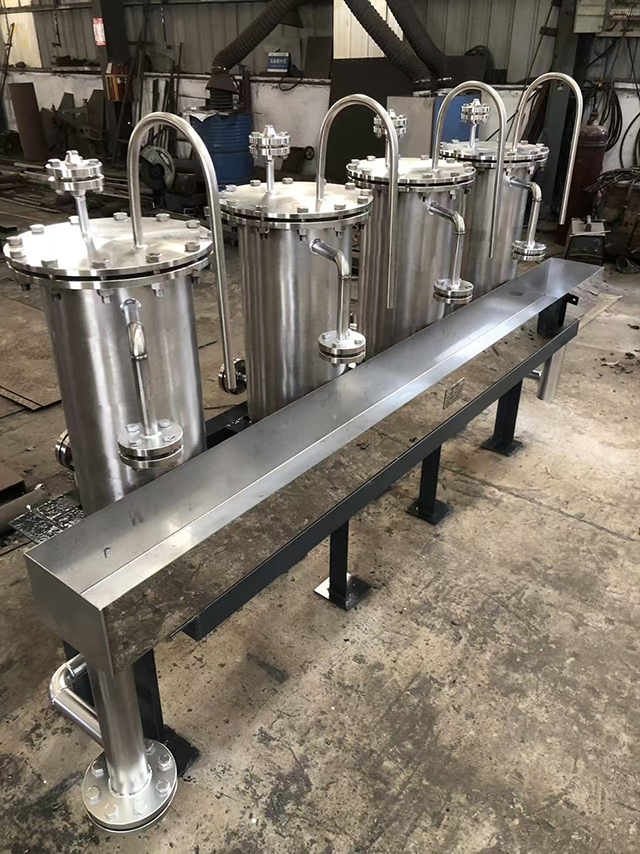
A sampling cooler is technically a type of heat exchanger, but it has a different primary purpose from a large process heat exchanger.
| Feature | Sampling Cooler | Conventional Heat Exchanger |
|---|---|---|
| Main purpose | Cool a process sample | Heat or cool a process stream |
| Typical size | Compact | Small to very large |
| Flow rate | Usually relatively low | Often much higher |
| Installation | Near sampling point | Process line or equipment system |
| Main concern | Safe and representative sampling | Overall process heat balance |
| Typical sample | Boiler water, steam, condensate | Process fluid |
| Cooling medium | Usually water | Water, steam, air, refrigerant, etc. |
| Instrument connection | Often directly connected to sampling system | Usually process piping |
| Maintenance | Generally simple | Depends on heat exchanger design |
The compact size of a sampling cooler makes it particularly suitable for point-of-use sampling stations.
The most obvious advantage is temperature reduction.
Hot boiler water and steam can cause severe burns. Cooling the sample before collection reduces the risk associated with direct contact with high-temperature fluids.
A properly designed cooler helps prevent flash steam and excessive temperature-related changes during sample collection.
Sampling coolers are normally much smaller than general-purpose process heat exchangers.
Coil-based and counter-current designs can provide effective heat transfer within a compact volume.
Many sample coolers are designed for point-of-use installation near the sampling point.
Stainless-steel construction can provide good resistance in water, steam, and many industrial applications.
Stable sample temperature can improve repeatability when testing parameters that are temperature-sensitive.
A single-coil design uses one continuous sample tube surrounded by cooling water.
It is simple, compact, and suitable for many boiler-water and condensate applications.
A double-coil configuration increases the effective heat-transfer path and can provide greater cooling capacity within a compact arrangement.
A coiled sample tube is installed inside a shell or body through which cooling water flows.
The sample passes through tubes while the cooling medium flows through the shell side.
High-pressure designs use specially selected tube materials, wall thicknesses, connections, and construction methods to withstand demanding sampling conditions.
Published industrial designs show that the pressure rating of the sample coil can be substantially different from the pressure rating of the outer body.
Flow arrangement has a direct influence on cooling performance.
In a counter-current arrangement:
Hot sample flows in one direction.
Cooling water flows in the opposite direction.
The temperature difference is maintained more effectively along the cooler.
This is a common arrangement for compact sampling coolers.
In a parallel-flow arrangement, both fluids travel in the same direction.
This arrangement may be used in certain designs, but it can provide different thermal performance from counter-current flow.
For many industrial sample cooling applications, counter-current flow is attractive because it provides efficient heat transfer within a relatively small heat-transfer area.
A sampling cooler should be installed according to the system design and the equipment manufacturer's technical documentation.
A typical arrangement includes:
Process Sampling Point → Isolation Valve → Sampling Cooler → Flow Control → Sample Outlet / Analyzer
The cooling-water side normally follows:
Cooling Water Supply → Cooling-Water Inlet → Sampling Cooler → Cooling-Water Outlet → Drain or Return
Important installation considerations include:
Install the cooler close enough to the sampling point to reduce unnecessary heat loss and delay.
Provide appropriate isolation valves.
Ensure the sample line is properly supported.
Avoid unnecessary bends and dead legs.
Provide adequate drainage.
Make sure cooling-water flow direction matches the design.
Check all pressure ratings.
Verify connection standards.
Provide sufficient space for inspection and maintenance.
Prevent accidental operator contact with hot surfaces where necessary.
The exact piping arrangement depends on the sampling system.
Regular maintenance helps maintain cooling performance and sampling accuracy.
Inspect the sampling cooler periodically for:
External corrosion
Leakage
Damaged fittings
Loose connections
Abnormal vibration
Discoloration
Blocked passages
Deposits can accumulate on the heat-transfer surface.
Possible contaminants include:
Scale
Mineral deposits
Rust particles
Suspended solids
Chemical residues
Cleaning methods depend on the material and process fluid.
Flushing the sample line can help remove accumulated deposits and reduce the risk of blockage.
The sample side and cooling-water side should be checked for leakage, particularly after maintenance.
Because the two fluids must remain separated, internal leakage can compromise sample quality and potentially create an unsafe condition.
Possible causes include:
Insufficient cooling-water flow
High cooling-water inlet temperature
Excessive sample flow
Fouled heat-transfer surface
Incorrect flow direction
Undersized cooler
Unexpectedly high sample inlet temperature
Possible causes include:
Blocked sample tube
Closed or partially closed valve
Scale buildup
Excessive pressure drop
Incorrect tubing arrangement
Possible causes include:
Low cooling-water pressure
Insufficient flow
High cooling-water temperature
Incorrect connection
Fouling
Internal blockage
Possible causes may include:
Unstable sample flow
Excessive sample temperature
Flashing
Poor sampling technique
Contamination in the sample line
Insufficient flushing
Temperature-sensitive analytical methods
Boiler water quality control is one of the most important applications of sampling coolers.
Boiler operators may monitor parameters such as:
pH
Conductivity
Total dissolved solids
Chemical concentration
Chloride
Silica
Phosphate
Dissolved oxygen
Other water chemistry parameters
The exact parameters depend on the boiler design, water-treatment program, fuel, operating pressure, and plant requirements.
A sample cooler provides a controlled interface between the high-temperature boiler system and the sampling or analytical equipment.
For this reason, a boiler water sample cooler should be considered part of the broader boiler water sampling system rather than an isolated component.
Power plants use sampling systems throughout the steam-water cycle.
Typical sample points can include:
Boiler drum water
Feedwater
Economizer outlet
Main steam
Reheat steam
Condensate
Deaerator water
Cooling water
Chemical dosing systems
Reliable sampling is important because water chemistry can influence corrosion, deposition, turbine performance, boiler efficiency, and equipment life.
A sampling cooler can provide a safer and more stable sample condition before manual testing or online analysis.
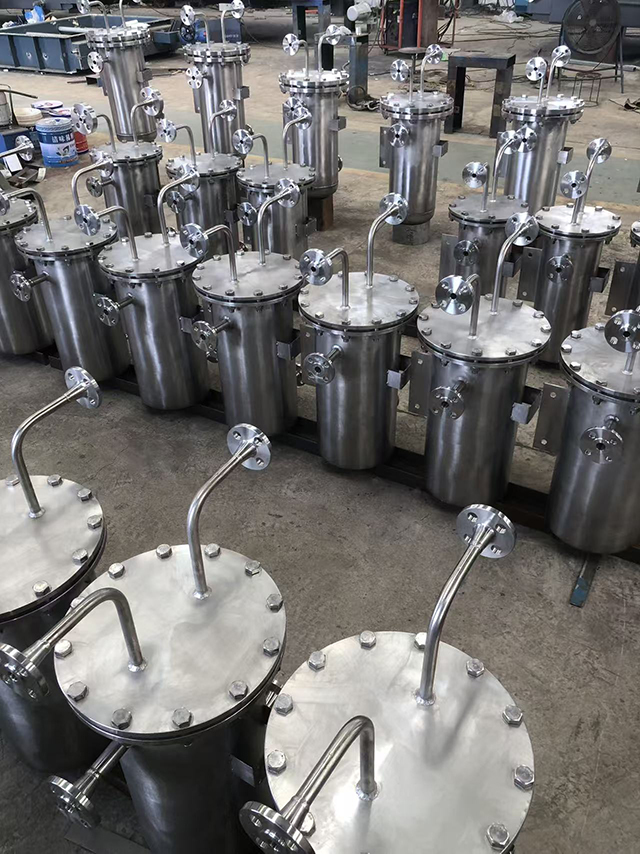
Material selection depends on temperature, pressure, fluid chemistry, corrosion resistance, cleanliness requirements, and operating environment.
| Material | Typical Characteristics |
|---|---|
| Carbon steel | Economical and suitable for selected cooling-water services |
| 304 stainless steel | General corrosion resistance |
| 316 stainless steel | Improved corrosion resistance |
| 316L stainless steel | Widely used for water, steam and sanitary-related applications |
| Nickel alloys | Suitable for more aggressive chemical environments |
| Hastelloy | Used for demanding corrosive services |
| Copper alloys | May be suitable for selected applications, subject to chemistry |
316L stainless steel is a frequently documented material for sample cooler coils and bodies.
However, material selection should always be based on actual fluid chemistry rather than assuming that stainless steel is suitable for every application.
A reliable sampling cooler should be designed around the complete operating envelope.
Key design inputs include:
Sample side
Fluid type
Inlet temperature
Outlet temperature
Operating pressure
Design pressure
Flow rate
Density
Viscosity
Specific heat
Thermal conductivity
Corrosiveness
Fouling tendency
Cooling-water side
Inlet temperature
Outlet temperature
Pressure
Flow rate
Water quality
Fouling tendency
Technical sample-cooler specification forms commonly request sample temperature, pressure, viscosity, specific heat, thermal conductivity, specific gravity, and cooling-water temperature and pressure as design inputs.
This information is important because heat-transfer calculations cannot be performed reliably from temperature alone.
A practical selection process can follow these steps:
Determine whether the sample is:
Boiler water
Feedwater
Steam
Condensate
Chemical liquid
Other process fluid
Record:
Maximum pressure
Normal pressure
Maximum temperature
Normal temperature
Sample flow rate
Determine the required sample outlet temperature based on:
Testing method
Analyzer requirements
Operator safety
Sampling procedure
Determine:
Cooling-water inlet temperature
Available pressure
Available flow
Water quality
Estimate the required heat-removal capacity using the sample flow rate, specific heat, and temperature reduction.
Select an appropriate tube or coil configuration based on the calculated duty and design conditions.
Confirm compatibility with both sample and cooling water.
The sample side and cooling-water side should be evaluated separately.
Match sample and cooling-water connections to the existing piping system.
Consider cleaning, flushing, inspection, and accessibility before finalizing the installation.
| Selection Item | Information Required |
|---|---|
| Sample medium | Water, steam, condensate, process liquid |
| Sample temperature | Normal and maximum |
| Sample pressure | Normal and maximum |
| Sample flow | Minimum, normal and maximum |
| Required outlet temperature | Target value |
| Cooling medium | Cooling water or other fluid |
| Cooling-water temperature | Minimum and maximum |
| Cooling-water flow | Available flow |
| Material | Based on corrosion compatibility |
| Connection type | NPT, BSP, tube, clamp, flange |
| Installation position | Horizontal or vertical |
| Cleaning requirement | Yes or No |
| Drainage | Required or not required |
| Instrument connection | Manual or online analyzer |
| Ambient conditions | Indoor or outdoor |
| Design standard | Project-specific requirements |
For search-engine optimization, relevant industry terminology can be naturally incorporated into technical content.
Primary keywords:
Sampling cooler
Sample cooler
Boiler water sample cooler
Boiler sampling cooler
Steam sample cooler
Condensate sample cooler
Feedwater sample cooler
Industrial sampling cooler
Secondary keywords:
Boiler water sampling
Steam sampling system
Condensate sampling
Boiler water quality
Sample cooling system
Industrial water sampling
High temperature sample cooler
High pressure sample cooler
Stainless steel sample cooler
Counter-current sample cooler
Boiler sampling system
Water quality monitoring
Long-tail keywords:
How does a sampling cooler work
What is a boiler water sample cooler
How to select a sampling cooler
Sampling cooler for boiler water
Sampling cooler for steam sampling
Sampling cooler for condensate
Stainless steel sampling cooler
High pressure boiler sample cooler
Industrial sample cooler working principle
Sample cooler heat exchanger design
These keywords should be integrated naturally rather than repeatedly inserted into every paragraph.
Modern industrial plants may combine manual sampling with online water chemistry monitoring.
An online analyzer can provide continuous measurement, while manual sampling provides an additional method for laboratory verification or calibration.
A sample cooler can serve both approaches, provided that the sample temperature and flow requirements of the analytical equipment are respected.
The sampling system may include:
Process → Isolation → Pressure Control → Sample Cooler → Flow Control → Analyzer / Sample Point
This arrangement can provide a controlled sample condition for downstream equipment.
Sampling from a high-temperature or high-pressure system requires careful engineering.
Operators should not assume that cooling alone makes every sampling system safe.
Important safety considerations include:
Correct pressure-rated components
Correct temperature-rated components
Appropriate isolation valves
Proper sample flow control
Adequate drainage
Leak prevention
Thermal insulation where required
Protection against hot surfaces
Correct installation
Routine inspection
Proper operating procedures
The sample cooler must be suitable for the actual maximum conditions of the process.
A sample cooler should never be treated as a substitute for pressure control or isolation equipment.
A sampling cooler is a compact heat exchanger used to cool hot process samples before collection or analysis. It is commonly used for boiler water, feedwater, steam, condensate, and industrial process liquids.
Boiler water can be hot and pressurized. Cooling the sample before collection can reduce burn hazards, minimize flashing, and provide a more suitable condition for water-quality testing.
A sample cooler is a specialized small heat exchanger designed primarily for sample conditioning. Conventional heat exchangers generally handle much larger process streams and perform broader heating or cooling duties.
Cooling water is the most common cooling medium, although other compatible cooling fluids can be considered for specialized applications.
Stainless steel, particularly 316 or 316L stainless steel, is widely used in many industrial sample cooler designs. More specialized alloys may be required for corrosive process fluids.
Yes. Sample coolers can be designed for steam sampling. The steam is cooled and typically condensed before collection or analysis.
Counter-current flow maintains a useful temperature difference between the sample and cooling water along the heat-transfer path and can improve cooling effectiveness.
Start with the sample type, inlet temperature, pressure, flow rate, required outlet temperature, cooling-water temperature and flow rate, and material compatibility. These parameters are necessary for proper heat-transfer and pressure-rating evaluation.
Yes. Condensate sampling is a common application, particularly in steam and boiler water systems.
Yes. Periodic inspection, flushing, cleaning, connection checks, and leak checks may be required depending on the service conditions.
A sampling cooler is a small but important component in industrial sampling systems. Its primary function is to remove heat from a high-temperature sample before the fluid reaches an operator, laboratory instrument, or online analyzer.
In boiler and steam systems, sampling coolers support safer and more reliable sampling of boiler water, feedwater, steam, and condensate. By controlling sample temperature and reducing the possibility of flash steam, they help create better conditions for water chemistry analysis.
The performance of a sampling cooler depends on more than its physical dimensions. Sample temperature, sample pressure, sample flow rate, cooling-water temperature, cooling-water flow, heat-transfer area, material compatibility, fouling potential, and required outlet temperature should all be considered during selection.
For industrial applications, stainless-steel coils and bodies are frequently used because of their durability and corrosion resistance. Counter-current heat-transfer arrangements are also common because they provide effective cooling in compact equipment.
When properly selected and installed, a sampling cooler can improve sampling safety, measurement reliability, water-quality monitoring, process control, and equipment protection. It is therefore an important part of modern boiler sampling systems, steam-water analysis systems, and industrial process monitoring equipment.
| Item | Key Information |
|---|---|
| Product name | Sampling Cooler / Sample Cooler |
| Main function | Cool hot samples before analysis |
| Typical samples | Boiler water, feedwater, steam, condensate |
| Main cooling medium | Cooling water |
| Heat-transfer type | Tube, coil, shell-and-coil, double-coil |
| Common flow arrangement | Counter-current |
| Common materials | Stainless steel, carbon steel, special alloys |
| Main benefit | Safe and reliable sample conditioning |
| Main industries | Power, boiler, chemical, petrochemical, manufacturing |
| Important design inputs | Temperature, pressure, flow, fluid properties |
| Main selection factors | Cooling duty, material, pressure, temperature, connections |
| Maintenance | Inspection, flushing, cleaning, leak checking |
Pulverized coal Sampling devices are indispensable specialized equipment in the pulverizing systems of…
FAQ
We manufacture power plant dampers (flue gas, desulfurization, high-temperature baffle doors), slide gate valves, blind flange valves, rotary film and sponge iron deaerators, venting silencers, automatic dosing devices, steam-water sampling devices and sampling coolers, coal powder samplers, condensate recovery units, coarse and fine powder separators, and plate / shell-and-tube heat exchangers.
We are certified to ISO 9001:2015 (quality), ISO 14001:2015 (environmental) and ISO 45001:2018 (occupational health and safety) management systems. We are also a qualified supplier of Sinopec, PetroChina, China Guodian Corporation, China Datang Corporation, CNOOC and Aluminum Corporation of China Limited.
Yes — most of our business is retrofit supply. Send us the duct cross-section, design temperature and media, or drawings, templates and photos of the existing installation. Our engineers will dimension the unit, its flange drilling and the actuator interface to bolt directly into your plant.
Louver-type double-layer dampers with sealing air achieve a leakage rate below 0.5%; fully sealed slide gates and coal mill isolation doors achieve zero internal and external leakage. Every damper is leakage-tested in the works before shipment and a factory acceptance test report is supplied.
Send duct data or drawings today — get an engineering review, itemized quotation and realistic lead time within 12 working hours.